For organizations
The credential nobody forgets at home
A Monday morning in your building
One of your employees is waiting at reception. Their badge is in a jacket at home, and now a colleague has to come down and vouch for them.
Another is on the phone with IT, asking for a password reset. It is their third this quarter, and everyone on that call knows the new one will look a lot like the old one.
A third has just received an email. The company is giving away the new iPhone, one per department, click here to claim yours. It looks right. The logo is right. They enter their password, and somewhere in another country, someone now has access to everything that person could reach. By the time anyone notices, it will be Thursday.
And on the far side of the building, a side door opens for a badge belonging to someone who was let go last month. Nobody ever asked for it back. They still have it, and they are still angry.
This is what happens when access depends on objects people are expected to carry, remember, and hand back.
The same morning, with SkinID
At the door.
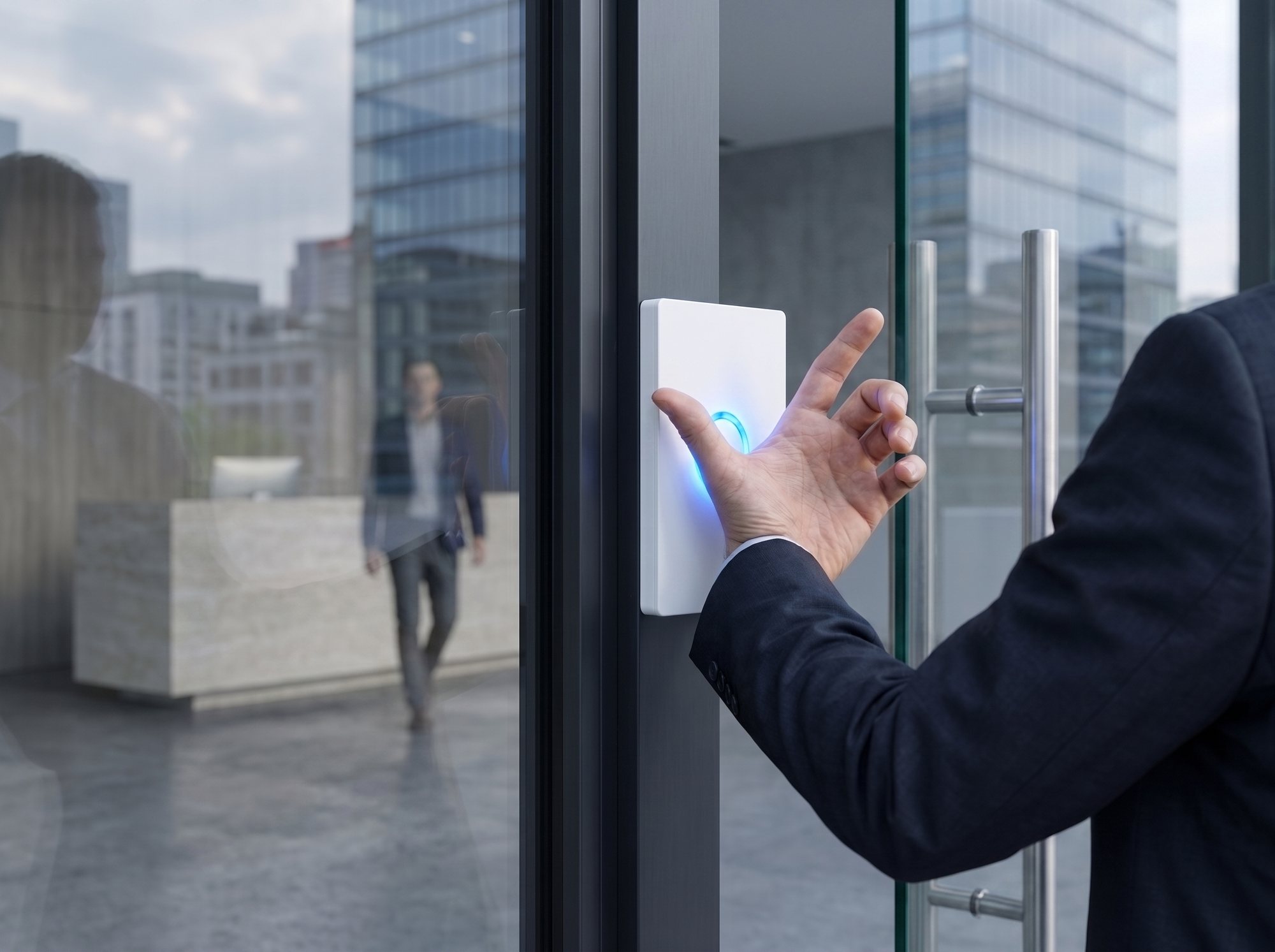
The first person walks up, holds up their hand, and walks in. Same at the lift. Same at their office. That is the whole story. There is nothing else to tell, because nothing else happened.
At the desk.
They sit down, hold up their hand, and the laptop opens. The internal tools open. The specialised software they need for the job opens. Every account, all morning, one gesture each time, nothing typed and nothing remembered. By ten o’clock they have thought about their work and nothing else.
And that email about the iPhone?
They still received it. They may still click it. But there is no password to type in, so there is nothing to give away. The page asks for something they do not have.
And the person who was let go?
They lost every access they had, the doors and the accounts, the moment HR clicked once. Before they reached the car park.
What it takes off your plate
A password is worth more than you think.
The average breach costs a company millions, and most of them start the same way: one login, reused somewhere it should not have been, or handed over to a page that looked real enough. It takes one person, one moment of inattention, on any given Tuesday.
Here, there is nothing to hand over. The credential never leaves your employee’s hand, and it cannot be typed into anything.
A badge has a life of its own.
Lost in a taxi. Lent to a contractor for the afternoon. Cloned for twenty francs by a device that fits in a pocket. Sitting in a drawer at a former employee’s home. Every one of those badges still opens your building tonight.
Your team’s credentials stay where they are, and they only ever work when the person is standing there.
The gap between the last day and the last access.
Every security team knows this one, and every security team has been caught by it. The accounts get closed on Friday, the badge gets forgotten, and three months later nobody is sure who still has what.
One click, and everything closes at once. Not the doors this week and the accounts next month. Everything, at the same second.
The password reset queue.
Somebody forgot theirs again. They file a ticket, somebody else handles it, both of them lose twenty minutes, and in ninety days it happens again.
That ticket stops existing. There is nothing left to forget.
Every access system you have ever used gave you a list. Who has a badge, who has an account, who has a key to the server room. Three lists, four systems, and nobody entirely sure they match.
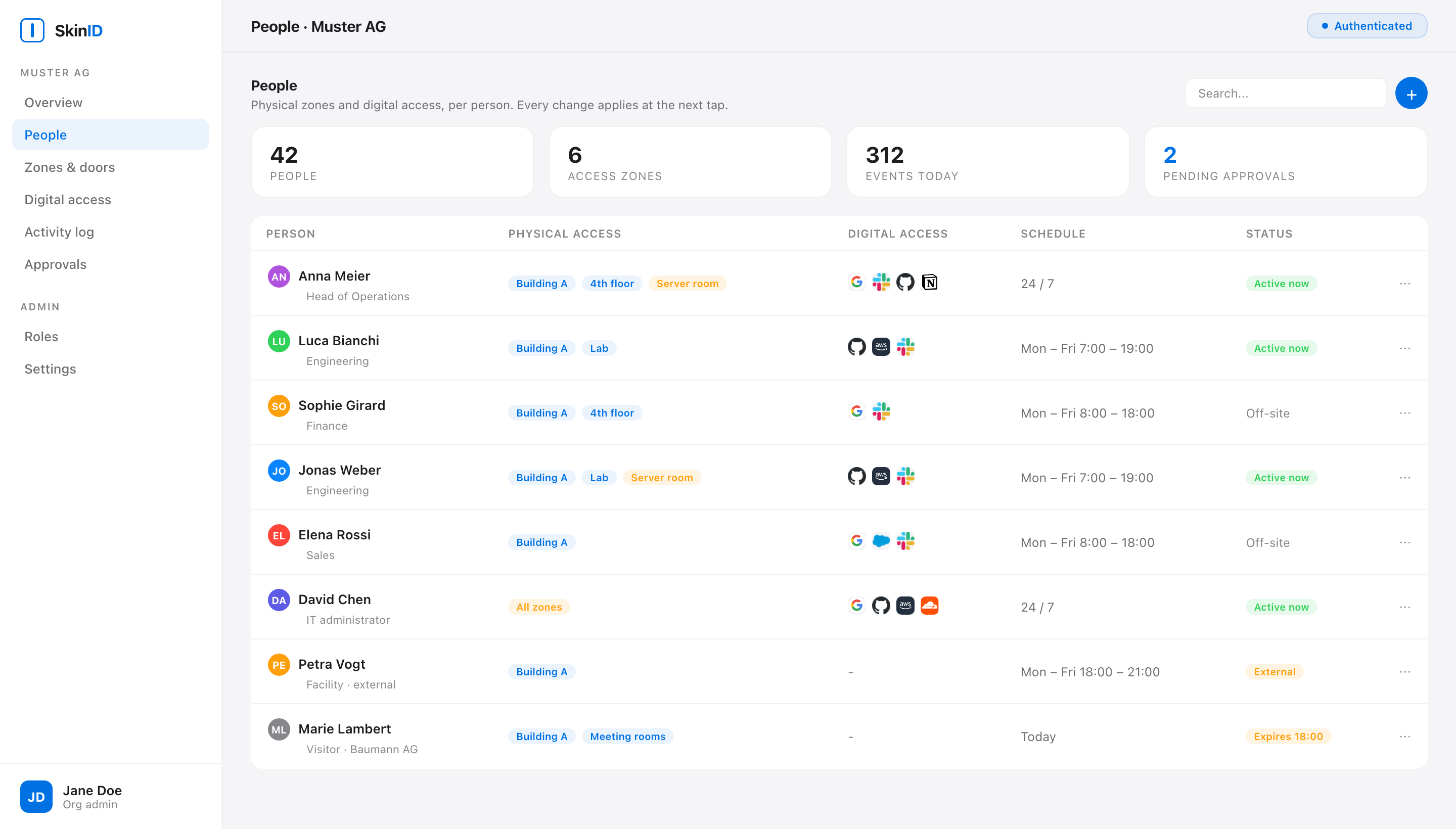
One dashboard. One list. Every person, every door, every account, every schedule, on one screen.
Someone joins on Monday.
You give them the floor, the meeting rooms, the tools their team uses, and the parking. Thirty seconds.
Someone changes role.
You move them, and their old access disappears in the same movement.
Someone leaves.
One click. The building, the lift, the server room, the laptop, every account they could reach. Gone at the same second, not spread over three weeks and four different people.
And when the auditor asks who opened the lab on the 14th of March at 21:40, you have the answer before they finish the sentence.
Where it works from day one
Office access.
Doors, lifts, meeting rooms, restricted zones.
Workstation login.
Windows and Mac open when the person is there.
Internal tools and SaaS.
Passwordless sign-in wherever passkeys are supported, and the vault fills in the rest.
We work with the systems you already have rather than replacing them. Compatibility depends on what is installed, so the first thing we do is look at yours.
For the people who ask the hard questions
Every security decision your team has made in the last ten years has been a compromise. Passwords were the problem, so you asked for longer ones. Longer ones get written down, so you bought a password manager. The manager has a master password, so you added a second factor. The second factor lives on a phone, so you wrote a policy. The policy has exceptions, so you added an audit. None of it fixed the thing underneath: the credential is still something a person has to hold, type or carry, and anything a person can hand over, someone will eventually take.
This is the first system where there is nothing to hand over.
The credential cannot leave the person.
It is not on a phone that gets stolen, not on a key you can hand to a colleague, not in a browser waiting to be scraped by malware. It is in a hand, and it works only when that hand is present.
Phishing stops working.
Not “becomes harder”. Stops. There is no password to type into a convincing page, no code to read out to someone claiming to be IT, no approval to tap through at eleven at night. The most successful attack vector in enterprise security has nothing left to attack.
The implant cannot be copied.
A badge is cloned in seconds with a device that costs twenty francs. This chip proves who it is with a key that never leaves it, that no reader can extract, and that no copy can reproduce.
Even we cannot read your data.
Credentials are encrypted before they reach us and we do not hold the keys. Not our engineers, not our support team, not anyone who breaches our servers, and not anyone with a court order. There is nothing on our side to hand over.
The master key lives in a hardware security module.
Dedicated tamper-resistant hardware. Never in a database, never exported, never in ordinary server memory.
Every access is auditable.
Full logs, exportable, per employee and per zone. When an auditor asks who opened the lab at 21:40, you answer immediately.
Two ways in
Talk to us.
Tell us what you have installed and what you are trying to fix. We will tell you honestly whether we can help yet.
Contact us →
Stay close.
Product updates, pilot invitations, and a direct line when commercial plans are ready.
Join the list →